
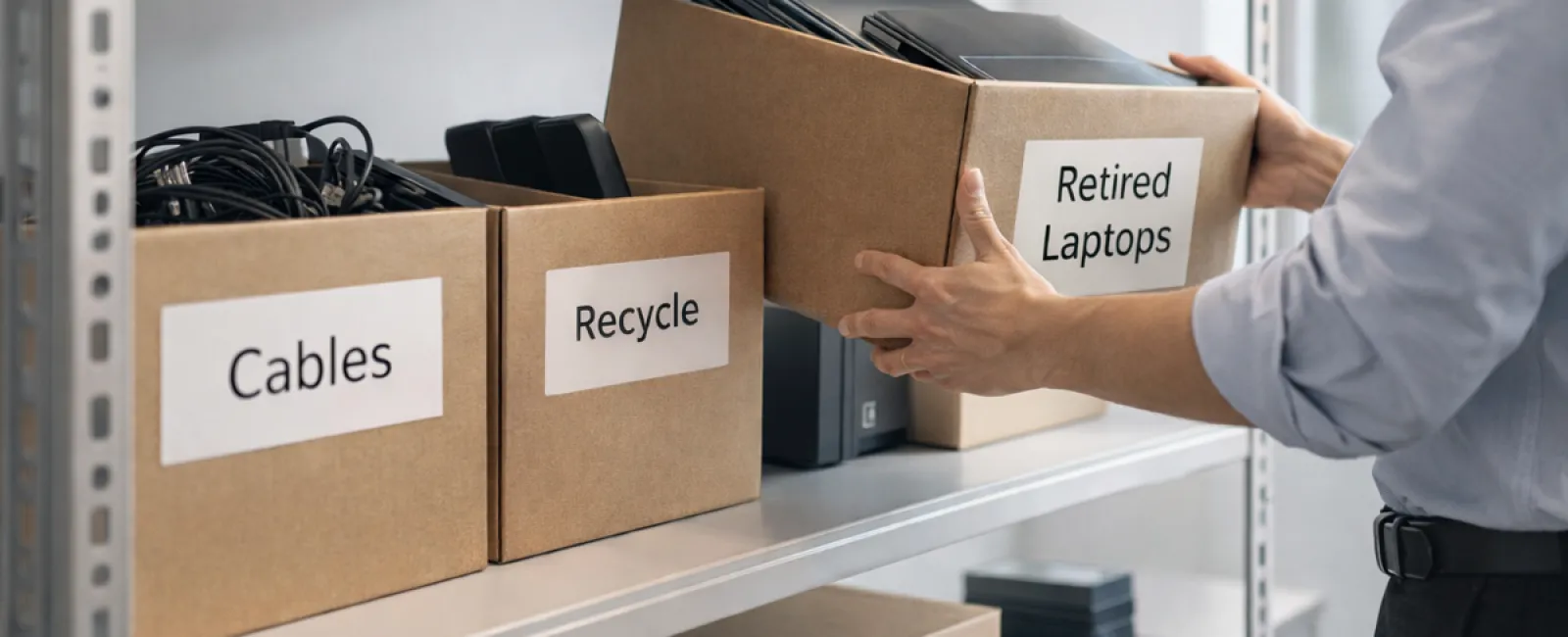
Most companies think of spring cleaning as a closet problem, but the bigger mess is usually hiding in plain sight.
It may be in a server rack, a storage room, a back office, or that corner labeled "we'll get to it later."
Outdated laptops. Discontinued printers. Backup drives from several upgrades ago. Loose cables saved for a "just in case" moment that never comes.
Every organization collects this kind of equipment.
The real question is not whether it exists. It's whether you know what should happen to it next.
Technology Has a Lifecycle — Not Just a Purchase
Date
Buying new technology usually comes with a clear business case. It's faster, more secure, more capable, and better aligned with growth.
Most businesses plan the purchase. Far fewer plan the retirement.
Retiring equipment often happens quietly. A device gets replaced, moved aside, and eventually forgotten until someone needs the space.
That part is normal.
What's less common is giving technology retirement the same level of planning as technology procurement.
Even old equipment can still hold value, recyclable materials, or sensitive data. And if it sits untouched, it can become a drain on space, time, and attention.
Spring is the perfect time to pause and ask: what is still useful, and what is simply taking up room?
A Practical Framework for Cleaning Up Your Tech
If you want this to be more than a "we should probably" conversation, start with this simple four-step process.
Step 1: Take inventory
What are you actually retiring? Laptops? Phones? Printers? Network equipment? External drives? You can't manage what you haven't identified, and a quick walkthrough usually uncovers more than expected.
Step 2: Choose the right path
Most devices fall into one of three categories: reuse them internally or through donation, recycle them through certified e-waste programs, or destroy them when data risk demands it. The important part is deciding on purpose instead of letting hardware drift into storage limbo.
Step 3: Prepare the device correctly
This is where a little discipline pays off.
If a device will be reused or donated, remove it from your management systems, revoke user access, and confirm a true data wipe, not just a factory reset. Deleted files and quick formats do not erase data; they only stop the system from showing where it lives.
A study by data security firm Blancco found that 42% of resold drives purchased on eBay still contained sensitive data, including personal tax records and passport information. Every seller claimed the drives had been properly wiped. Certified erasure tools overwrite every sector and provide verification reports.
If the device is being recycled, use a certified e-waste provider instead of sending it to the curb or dumpster. One important note: Best Buy's recycling program is for household residents only, not businesses.
For commercial equipment, work with a certified IT asset disposition (ITAD) provider or a business-focused e-waste recycler. Look for e-Stewards or R2 certification, both of which have searchable directories at e-stewards.org and sustainableelectronics.org. Your IT provider can usually help coordinate the process too.
If the equipment must be destroyed, use certified wiping or physical destruction methods such as shredding or degaussing, and keep records of the device serial number, the method used, the date, and who handled it.
This isn't about overthinking it. It's about closing the loop the right way.
Step 4: Record it and move forward
Once equipment leaves your building, you should know where it went, how it was handled, and whether access was removed. Good documentation eliminates guesswork later.
The Devices People Forget About
Laptops usually get the most attention. Other devices often don't.
Phones and tablets can still hold email access, contact lists, and authentication apps. A factory reset removes most of it, but a certified mobile wipe is more complete for business use. Apple, Samsung, and most major manufacturers also offer trade-in programs for older devices, which may reduce the cost of replacements.
Modern printers and copiers often contain internal hard drives that store copies of everything printed, scanned, copied, or faxed. If you are returning a leased copier, get written confirmation that the drive will be wiped or removed before the machine is redeployed.
Batteries are considered potentially hazardous waste by the EPA, and in several states, including California, New York, and Minnesota, businesses cannot throw rechargeable batteries in the regular trash. Remove them when possible, tape the terminals to prevent short circuits, and take them to a certified drop-off site. Call2Recycle.org offers a searchable map, and Staples, Home Depot, and Lowe's accept rechargeable batteries at most locations.
External drives and retired servers often end up sitting in closets longer than planned. They may not be problems by default, but they still deserve a formal retirement process.
A Quick Word on Recycling
April usually brings Earth Day reminders, and that's worth paying attention to.
Electronics should not wind up in landfills. More than 62 million metric tons of e-waste are generated each year, and only about 22% is properly recycled. Batteries, monitors, and circuit boards belong in approved recycling streams, and most communities offer certified e-waste options for that reason.
When technology is retired the right way, the process is efficient, environmentally responsible, and strategically smart. You do not have to choose between secure and responsible. You can have both.
It also gives you something positive to share publicly. Customers notice when businesses handle details well without making a spectacle of it.
The Bigger Opportunity
Spring cleaning is not really about throwing things away. It is about creating room for what matters next.
Clearing out obsolete equipment is one part of that. But once you're reviewing hardware, it's worth asking a bigger question: is your technology helping your business operate the way you want it to?
Hardware comes and goes. Today, productivity and profitability are driven more by software, systems, automation, and process design.
Retiring old equipment properly is smart housekeeping. Making sure the rest of your technology supports your goals is what keeps progress moving.
Where We Come In
If you already have a clear process for retiring equipment, that's ideal. It should feel routine, not stressful.
But while you are making decisions about old hardware, it is also a good time to look at the bigger picture. Are your systems streamlined? Do your tools work well together? Is your technology helping you grow, or just keeping everything running?
If you want to step back and evaluate how your tech stack, systems, and processes are affecting productivity and profitability, we would be glad to talk.
No checklist. No pressure. Just a straightforward conversation about how technology can better support your business.
Click here or give us a call at 801-356-9333 to schedule your free 15-Minute Discovery Call.
And if this brought another business owner to mind, feel free to share it.
Spring cleaning should not end with closets. It should include the systems that keep your business moving.