
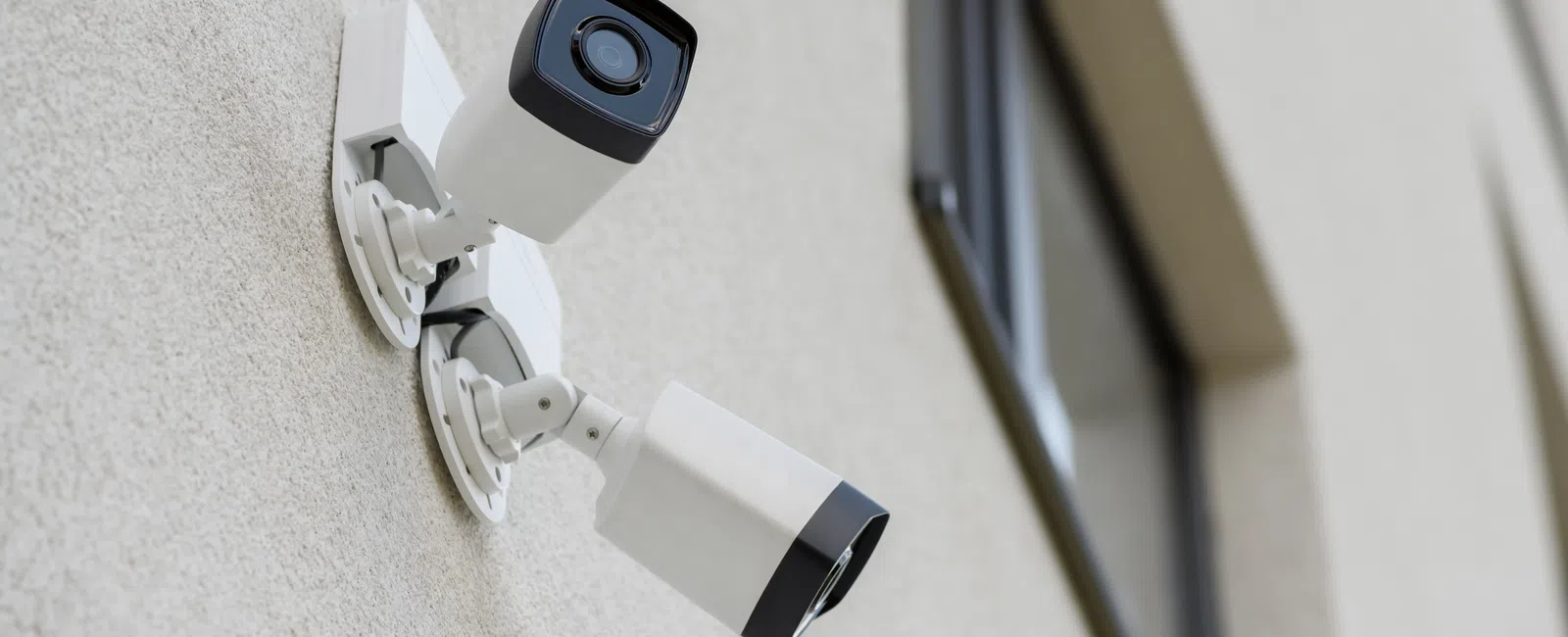
A retail shop owner installs four budget cameras above the checkout counter and only then realizes they have zero outdoor coverage after a smash-and-grab in the parking lot that was never recorded. The gap between indoor vs outdoor business security cameras is not a minor technical detail. It is the difference between footage that holds up and a blank screen when you need it most.
Indoor and outdoor security cameras are not interchangeable product tiers. They are engineered for fundamentally different operating environments. Outdoor cameras are built to survive UV exposure, freeze-thaw cycles, and physical tampering. Indoor cameras are optimized for image clarity under controlled artificial lighting. Treating them as equivalent is a common and costly mistake.
Engineering Requirements: Indoor Cameras vs. Outdoor Cameras
Consider a retail backroom: the lighting is consistent, the temperature is stable, and the camera's only job is to capture clear images of a controlled space. Now consider a loading dock: the camera faces direct sun in summer, sub-zero wind in a January in Utah, and the occasional deliberate attempt to knock it off the wall.
Those two environments require different housings, different sensor configurations, and different resistance ratings. A camera built for the backroom will physically degrade on the loading dock, not over years, but within a single season.
Outdoor cameras carry IK ratings because vandal resistance is a real threat. Indoor cameras skip that housing mass in favor of form factors that blend into office and retail environments without drawing attention.
What Makes an Outdoor Business Camera Different: Weatherproofing, IR Range, and Vandal Resistance
Outdoor commercial security cameras must meet three hardware benchmarks that indoor units are not designed for: IP66 or IP67 ingress protection against dust and water, infrared night vision ranging from 30 to 100-plus feet, and IK10-rated vandal-resistant housing. Each spec maps directly to a real-world threat that indoor cameras simply cannot address.
IP66 and IP67 Ingress Protection Ratings
IP67 means the camera is fully dust-tight and can survive immersion in water up to one meter. In practical terms, IP67 means the camera survives a Utah hailstorm, a Colorado Springs flash flood, and a high-pressure hose-down of a parking structure. An indoor camera with no IP rating will show degraded image quality, or stop functioning entirely, after its first hard rain season.
Infrared Night Vision Range
Infrared night vision range determines how far a camera can see in complete darkness. A small storefront entrance may need only 30 feet of IR coverage. A manufacturing facility's perimeter or a large parking lot may require cameras rated for 80 to 100-plus feet.
Undershooting this spec leaves a dark gap at the edge of your lot, exactly where a vehicle break-in or after-hours intrusion is most likely to occur.
IK10 Vandal-Resistant Housing
A manufacturing facility in Northern Utah learned this the hard way: an outdoor perimeter camera without a heated housing lost reliable image quality after a single winter. Repeated freeze-thaw cycles caused the lens seal to fail, allowing condensation to cloud the sensor. The IK10 housing alone would not have prevented that — the camera also needed a built-in heater rated for sub-zero temperatures.
Commercial-grade outdoor cameras designed for Mountain West climates account for both impact resistance and thermal management. Consumer-grade units do not.
What Indoor Business Cameras Are Actually Optimized For
Indoor surveillance cameras for business are built around image quality rather than environmental durability. Higher resolution sensors, wide dynamic range for mixed lighting, and discreet form factors like dome cameras for offices or PTZ units for open floors, make indoor cameras the right tool for internal spaces where weather and vandalism are not factors.
Dome Cameras for Offices and Retail Environments
Dome cameras are the standard choice for reception areas, retail sales floors, and client-facing spaces. Their low profile reduces the visual disruption of visible security hardware while still providing clear, wide-angle coverage.
PTZ Cameras for Open Warehouse and Production Floors
PTZ cameras are the right call for large open interiors like warehouse floors or production areas where a fixed camera's field of view would leave coverage gaps.
HIPAA Compliance Considerations for Healthcare Environments
Medical and dental practices face an additional constraint that retail and professional services businesses do not. Indoor cameras placed in patient areas or near exam rooms must account for HIPAA compliance considerations, including who can access recorded footage and how that footage is stored and retained.
Camera placement in healthcare settings is not just a security question. It is a compliance question that requires deliberate planning before installation begins.
Common Mistakes Businesses Make When Buying Security Cameras Without a Plan
Most camera coverage failures come from three avoidable mistakes made before a single camera is installed. Each mistake stems from buying hardware without first mapping it to the specific threats and environments in the building.
Three Mistakes That Leave Businesses Exposed
- Mounting an indoor camera outdoors: All-indoor camera kits are frequently installed with one unit above the back door. That camera will show water damage, fogging, or total failure within a single season of inclement weather and the owner will not know until they need the footage.
- Overlapping fields of view that still miss the loading entrance: Two cameras pointed at the same aisle leave the actual threat zone, the loading bay or side entrance, completely uncovered. More cameras in the wrong places is not the same as coverage.
- Recording only to an on-site DVR with no offsite backup: A DVR is a physical device. If it is stolen during the same break-in being investigated, the footage is gone. Business video surveillance systems without offsite or cloud backup have a critical single point of failure that a non-expert buyer would never think to ask about.
Frequently Asked Questions
What IP rating do outdoor business security cameras need?
Outdoor business security cameras should carry a minimum IP66 rating, which means full dust protection and resistance to powerful water jets. IP67 is preferred for environments with standing water or heavy precipitation. In Mountain West climates with hail, heavy snow, and freeze-thaw cycles, IP67-rated cameras are the practical standard for reliable year-round performance.
Can I use an indoor security camera outside for my business?
No. Indoor security cameras lack the IP-rated housing, heated enclosures, and vandal-resistant construction required for outdoor use. Mounting an indoor camera outside will result in lens fogging, moisture infiltration, and eventual sensor failure — often within a single season in Mountain West climates. An outdoor-rated camera is not interchangeable with an indoor unit.
How long should a small business keep security camera footage?
Most small businesses retain security camera footage for 30 to 90 days. Businesses in regulated industries — healthcare, finance, retail with high transaction volume — may need longer retention periods to satisfy compliance requirements. Storage capacity in the recording system should be sized to match the intended retention window before installation is finalized.
Can indoor and outdoor business cameras run on the same system?
Yes. A single NVR (Network Video Recorder) can manage both indoor and outdoor cameras simultaneously, provided all cameras use a compatible protocol — typically ONVIF or the NVR manufacturer's supported standard. A unified system simplifies monitoring and recording management, allowing footage from all zones to be reviewed from one interface or remotely.
Not Sure Which Cameras Your Business Actually Needs? Let's Walk Through Your Space
In a free 15-minute discovery call, a Digital DataComm specialist will review your building layout, coverage gaps, and environment to recommend the right mix of indoor and outdoor cameras.
Schedule Your Free Discovery Call